Building open source for better statistics
Terrence Jorgensen awarded €1.5 million to further develop statistical software
23 March 2026
The lavaan package began life as a kind of hobby project by a single developer, Yves Rosseel, who felt that the R environment lacked user‑friendly software for structural equation modelling (SEM). He therefore decided to build a package that would be as easy to use as popular commercial software, but open source and freely accessible.
Terrence, now an Assistant Professor of Methods and Statistics at the UvA, met Rosseel during his PhD. He became enthusiastic about lavaan and started helping others online to use it. By now, Terrence has become one of the most advanced users and contributors to the programme.
You have been working with lavaan for many years. You help to build the software and you support researchers around the world in using it. Does this grant feel like recognition for all that work?
‘Definitely – and we have also spent years trying to secure this grant. To be clear: it is not a traditional research grant, but funding specifically intended to build open science infrastructure. For example, we are not allowed to fund PhD positions with it. Although 45 projects were funded by this NWO grant, this is the only one awarded to the University of Amsterdam (although 2 were awarded to AUMC).
The total budget is €1.5 million, spread over four years. The main components will be carried out at the Universities of Amsterdam and Twente, but it is a consortium grant, involving collaboration between eight Dutch universities and Ghent University in Flanders (where lavaan was born).’
What exactly will you be doing?
‘We are going to improve and expand the software so that researchers worldwide can analyse complex data in a fair, transparent and affordable way. In addition, there are many methodological researchers who already work to expand lavaan’s capabilities, and we want to redesign the software to make it easier for contributors to add their own pieces to the project. For both users and developers of the lavaan ecosystem, we will develop accessible teaching materials to build a broad community that works together on the further development of lavaan.’
Why is that important?
‘Open source is a cornerstone of open science. SEM software has traditionally been mainly commercial, and the most popular packages operate as a black box: you do not really know what is happening under the bonnet.’
How problematic is that?
‘That is bad news for science, because it means analyses are not fully transparent and are hard to reproduce. Other developers have spent years trying to work out what commercial software actually does, only to find that practice does not always match the documentation. That is not what you want if you aim to do reliable science. With open software such as lavaan, everything is checkable. Furthermore, development of new methods should not be driven primarily by the interests of commercial software designers. Software options can play a big role in shaping (or limiting) what kinds of research questions scientists even consider investigating! Our project will enable a very diverse research community to more democratically influence how new methods are developed according to the rapidly evolving types of data our world is now producing.’
What would you like to have achieved in four years’ time?
‘A stable, well‑documented and extensible lavaan, plus accessible textbooks and training materials for both users and developers. That will make it easier to develop best practices together and to conduct statistically responsible research using open and transparent tools. And it will mean we have laid a foundation on which the international community can continue to build. That last part is crucial as well, because software development is always a work in progress.
And given the role of SEM in testing scientific theories, this can do a lot to empower researchers to design the software to answer their real questions, rather than limit their research questions to fit the software.’
More information about the projects that were awarded
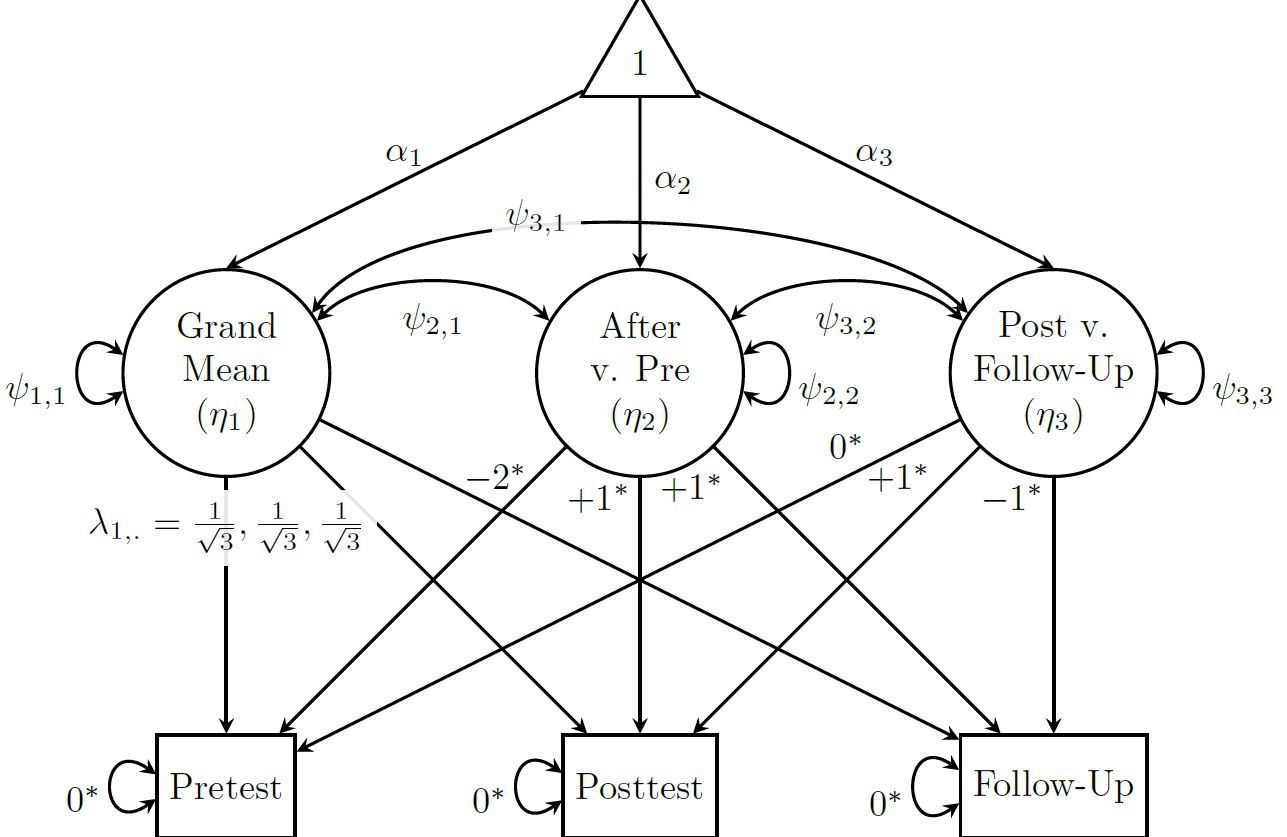
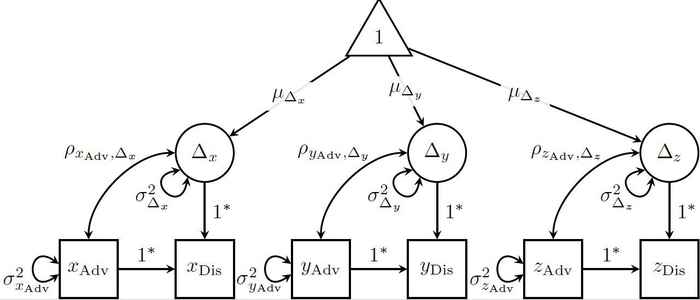
In pictures: path diagrams in lavaan (click on the images to enlarge)